Teneray
Restoring Finger Sensation in Prosthetic Hands
What:
Mechanical Design, Rapid Prototyping, Sensory Feedback
Who:
Imperial College London and Royal College of Art
When:
2025
Context:
Myoelectric prosthetic hand users face frustration and fatigue because they cannot feel where their fingers are. Without any sense of finger position, they must rely on visual monitoring or guesswork, making everyday tasks slow and mentally taxing. This lack of feedback contributes to a high abandonment rate, with one in four prosthetic hands returned. Existing solutions involve invasive, high-cost surgical implants or bulky, unintuitive electronics.
Outcome:
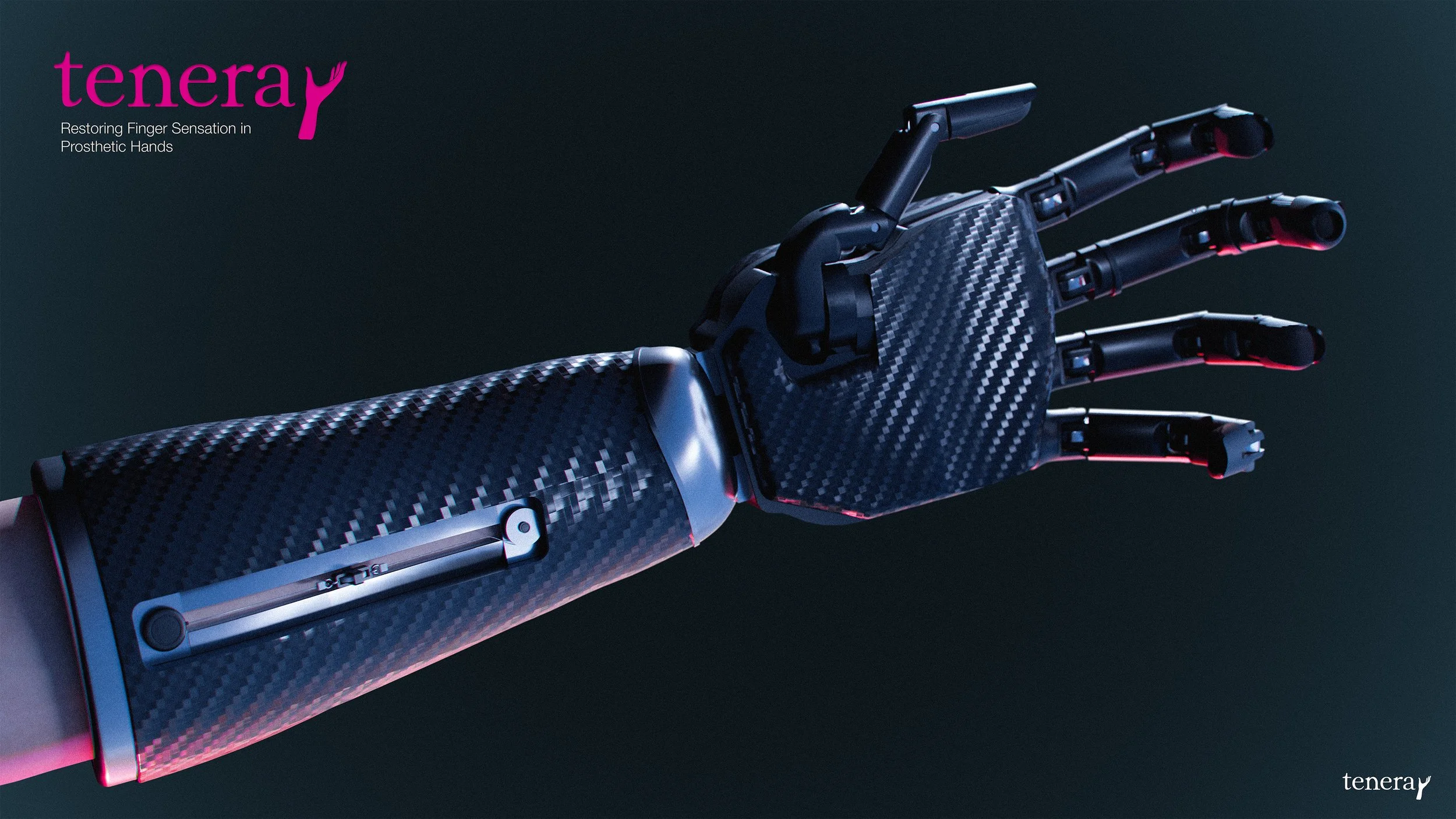
Teneray translates prosthetic hand finger movement into tactile feedback on the forearm, restoring a sense of finger position for people with upper limb differences. This improves coordination, reduces fatigue, and decreases prosthetic hand abandonment rates.
My Role:
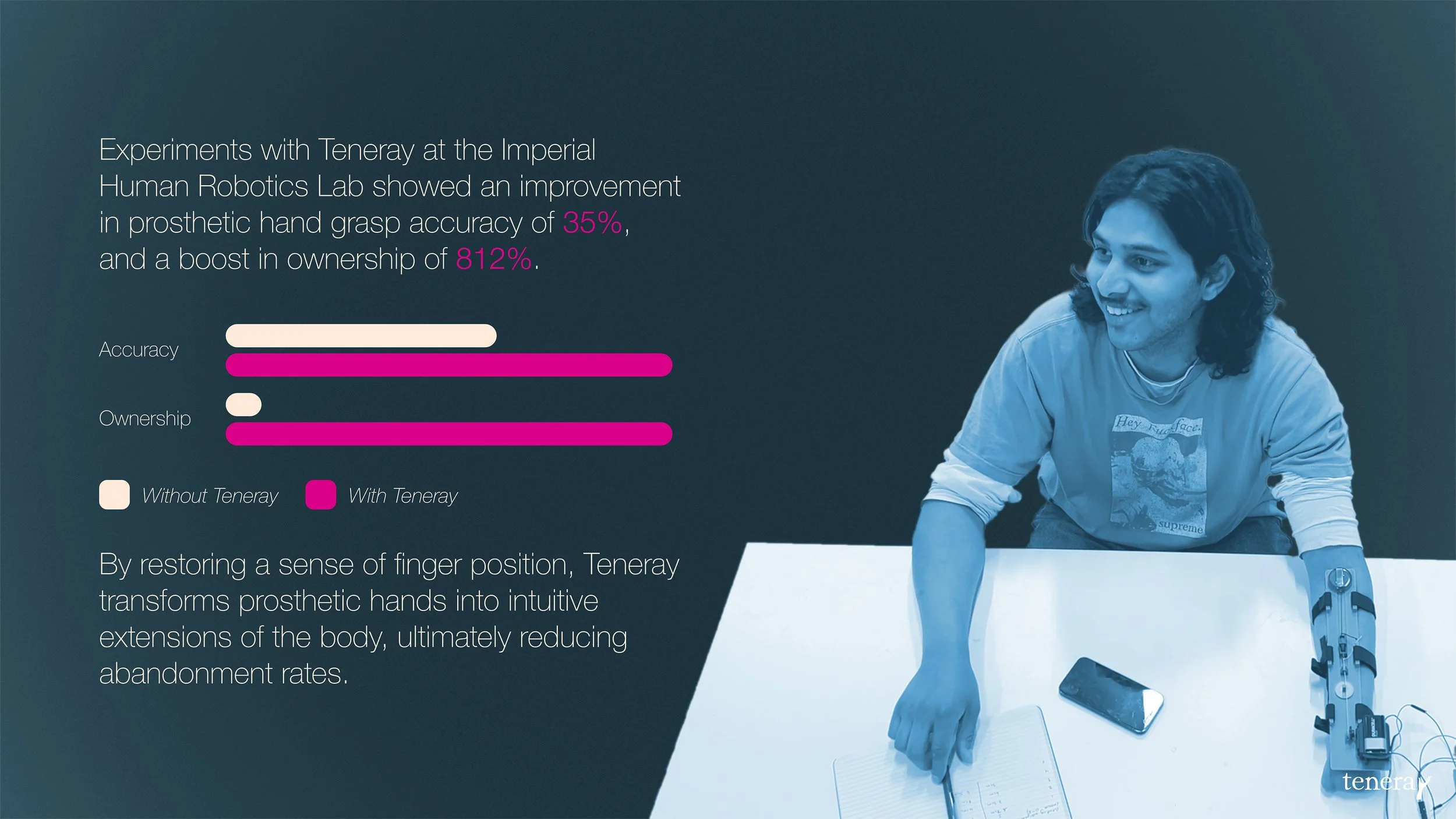
I tested various feedback methods with prosthetic hand users to find the optimal feedback type and location. I used 3D printing and mechanical design to solve various engineering challenges, and I worked with the Imperial Human Robotics Lab to run 2 experiments with a cohort of 20 to validate Teneray.
Awards and Press:
InnovationRCA Patent Award, Winner, 2025
Patent filed: “Sensory Feedback Device For A Myoelectric Prosthesis”. Patent application number: GB2510626.1
The James Dyson Award National Shortlist
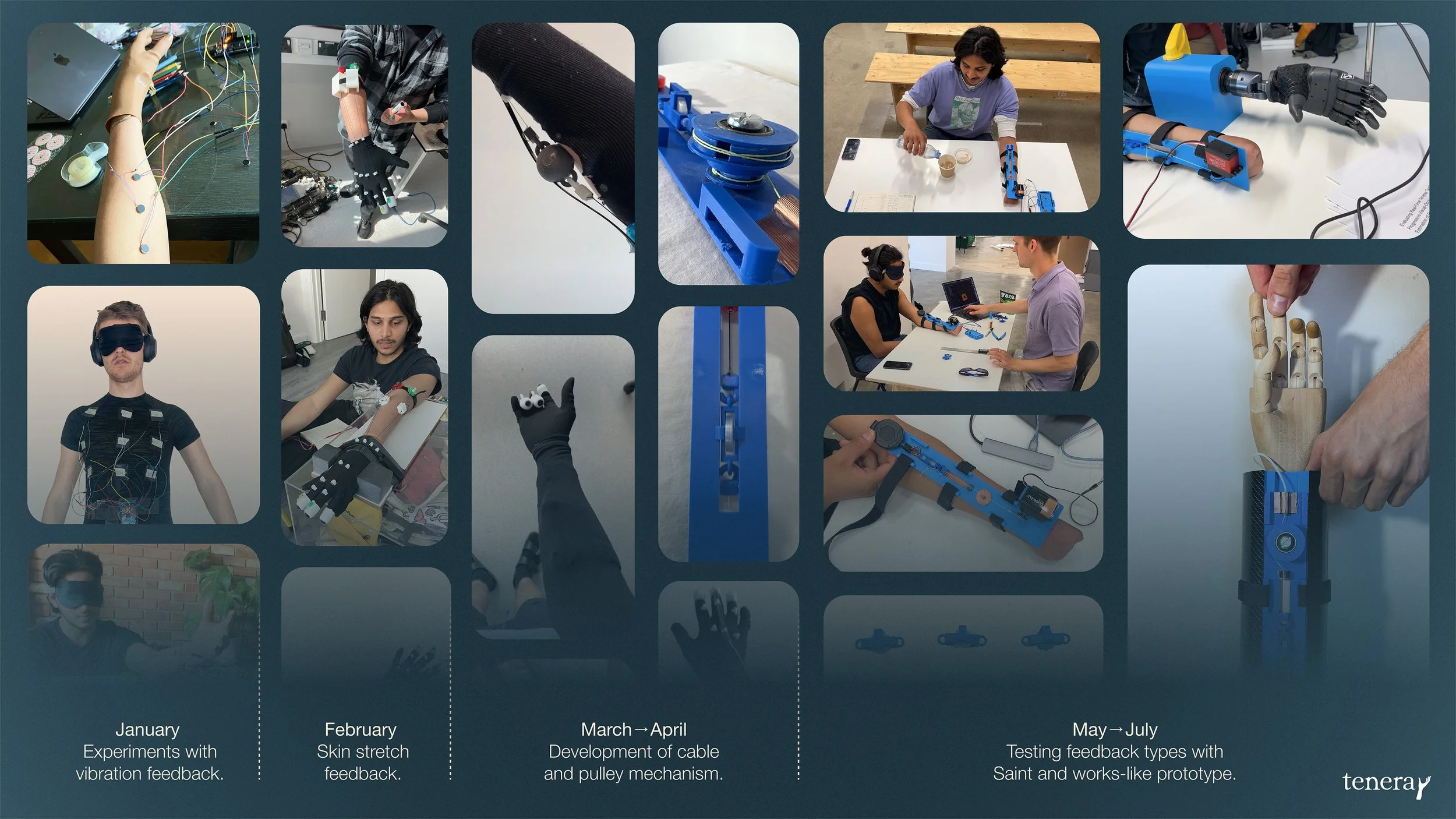
My friend Saint was born with a partial left hand, and trialled a muscle-controlled, myoelectric prosthetic hand. However, he abandoned it after three months because it gave him no sense of where his fingers were. He told me how hard it was to monitor his hand all the time, making simple tasks frustrating and tiring, and turning what should be a natural extension of the body into a cumbersome device. Saint is not alone: 1 in 4 prosthetic hands are abandoned due to a lack of feedback and functionality. Saint’s experience inspired me to find a method to restore finger position sensation in an intuitive, immediate, and non-invasive way.
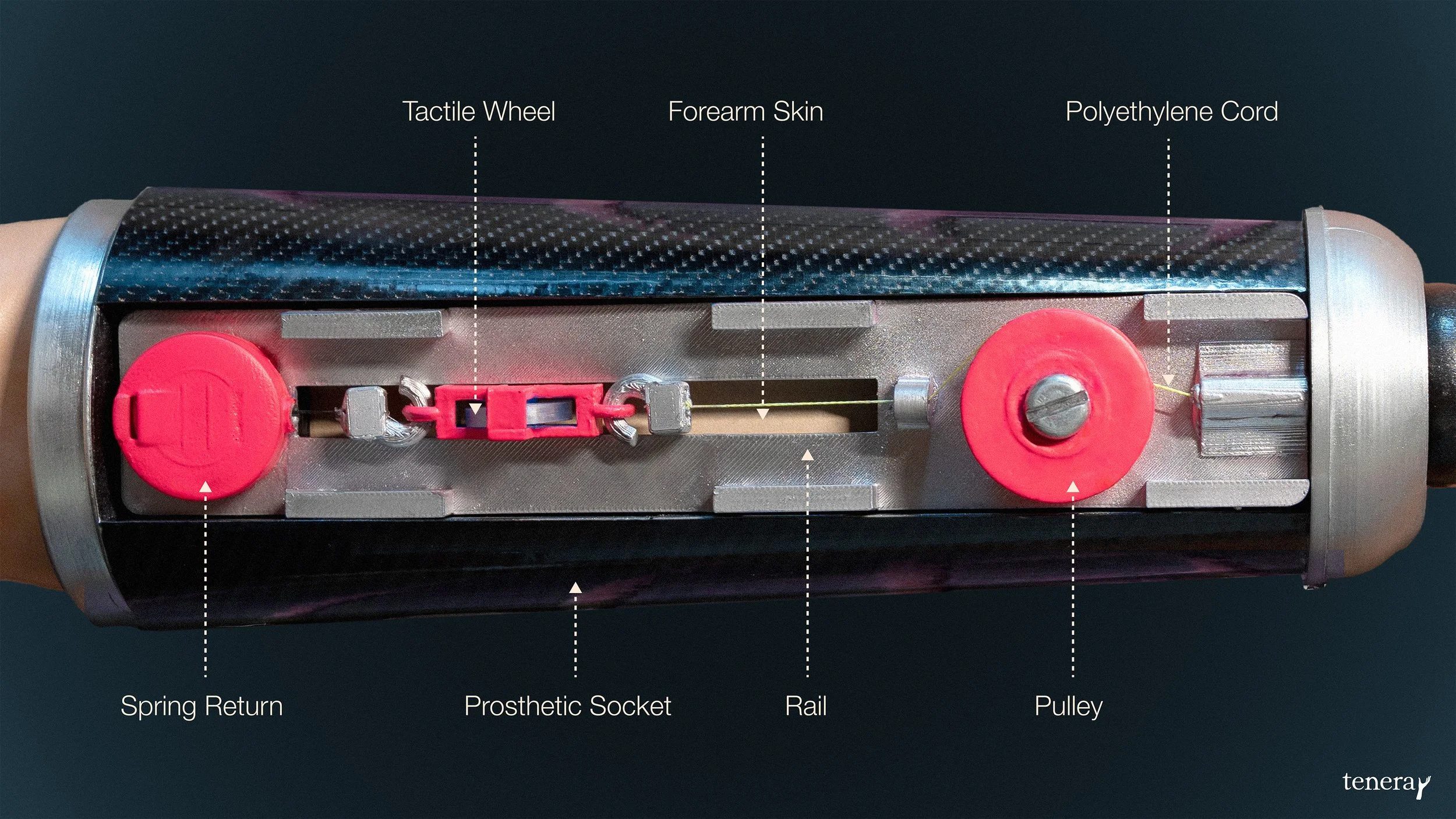
Teneray contains no electronics and is driven entirely by the existing motors in a myoelectric prosthetic hand. Each prosthetic finger is linked to a small pulley via a Bowden cable routed around the wrist, similar to those used for bike brakes. When a finger flexes, cable tension rotates the pulley, causing a small wheel to roll along the hairless, sensitive skin of the lower forearm. As the finger extends, a spring return pulls the wheel back in the opposite direction, creating a one-to-one mechanical feedback loop which delivers instantaneous, direction-specific information on prosthetic finger angle.
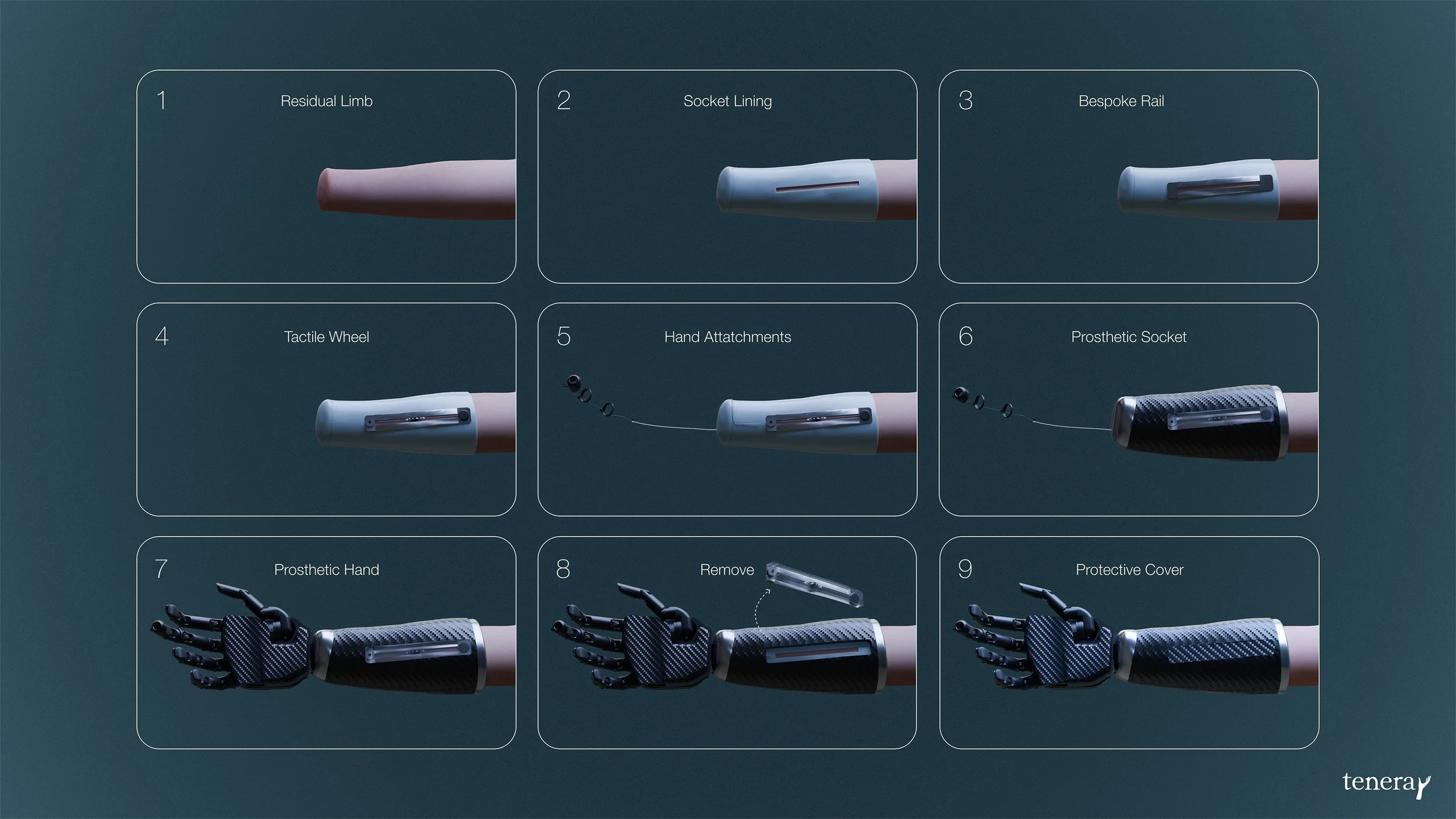
From a commercial standpoint, material costs remain under £5 per module while the envisioned retail price of £200 per finger promises gross margins above 90%. Forecasts anticipate cumulative revenues of £7.5 million by 2030. Beyond current myoelectric hand users, there exists a vast untapped market of millions worldwide who would value an integrated feedback solution, where Teneray would be installed within the prosthetic hand socket by a clinician.